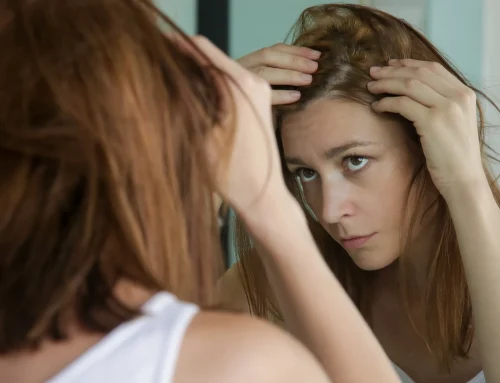
Hair Shedding vs. Hair Loss: What Women in Palatine Should Know
Finding more hair in your brush, noticing a wider part, or seeing less fullness around your temples can feel unsettling. The first thing to know is that hair shedding and hair loss are not always the same. Understanding the difference can help you decide what kind of support you may need—and it can make the next step feel less overwhelming.
What is normal hair shedding?
Every strand moves through a natural growth cycle. At the end of that cycle, the hair releases so a new strand can eventually grow. A temporary increase in shedding may occur several months after a major stressor such as illness, surgery, rapid weight change, childbirth, emotional stress, or a medication change. Dermatologists call this type of excessive shedding telogen effluvium.
Shedding often appears as hair coming from all over the scalp rather than one sharply defined area. Because several triggers can overlap, a professional evaluation is more useful than trying to diagnose the cause by counting hairs at home.
How hair loss may look different
Hair loss can involve gradual miniaturization, breakage, inflammation, or changes in the follicles. Women may first notice a widening part, a thinner ponytail, reduced coverage at the crown, or recession near the hairline. Patchy loss, scalp pain, burning, scaling, sores, or a shiny area without visible follicle openings deserves prompt attention from a board-certified dermatologist.
The American Academy of Dermatology explains that an accurate diagnosis may involve a health history, examination of the scalp and nails, a gentle pull test, and—when medically appropriate—bloodwork or a scalp biopsy. No single treatment is right for every type of hair loss, which is why identifying the cause matters.
What a trichology-informed salon consultation can do
A salon consultation does not replace medical diagnosis or treatment. It can, however, provide a calm place to document visible changes, discuss hair and scalp habits, identify cosmetic stressors, and explore ways to protect fragile hair. At StyleOnsite, we can also help you consider cuts, color placement, toppers, wigs, and other non-surgical options that support confidence while you pursue medical answers when needed.
When should you contact a dermatologist?
- Your loss is sudden, patchy, painful, or rapidly progressing.
- Your scalp is red, inflamed, scaly, tender, or developing sores.
- You are also experiencing unexplained fatigue, weight changes, cycle changes, or other new symptoms.
- You suspect a medication or health condition may be involved. Do not stop prescribed medication without speaking with the prescribing clinician.
- Your shedding continues or your density is visibly decreasing.
Gentle steps you can take now
Avoid tight styles and aggressive brushing, reduce unnecessary heat, handle wet hair carefully, and keep notes about when the change began. Bring a medication and supplement list to medical appointments. Clear photos taken in consistent lighting can also help show whether the pattern is changing over time.
You do not have to minimize what you are seeing or figure it out alone. StyleOnsite offers private, pressure-free hair restoration and alternative-hair consultations in Palatine for people experiencing thinning, shedding, or medically related hair loss.
Request a private consultation at StyleOnsite, 39 W. Slade Street, Palatine, IL, or call (847) 791-4049.
This article is educational and is not medical advice. StyleOnsite does not diagnose or medically treat hair-loss conditions.